
Behind the Frontlines: Shining a light on our Incredible Team
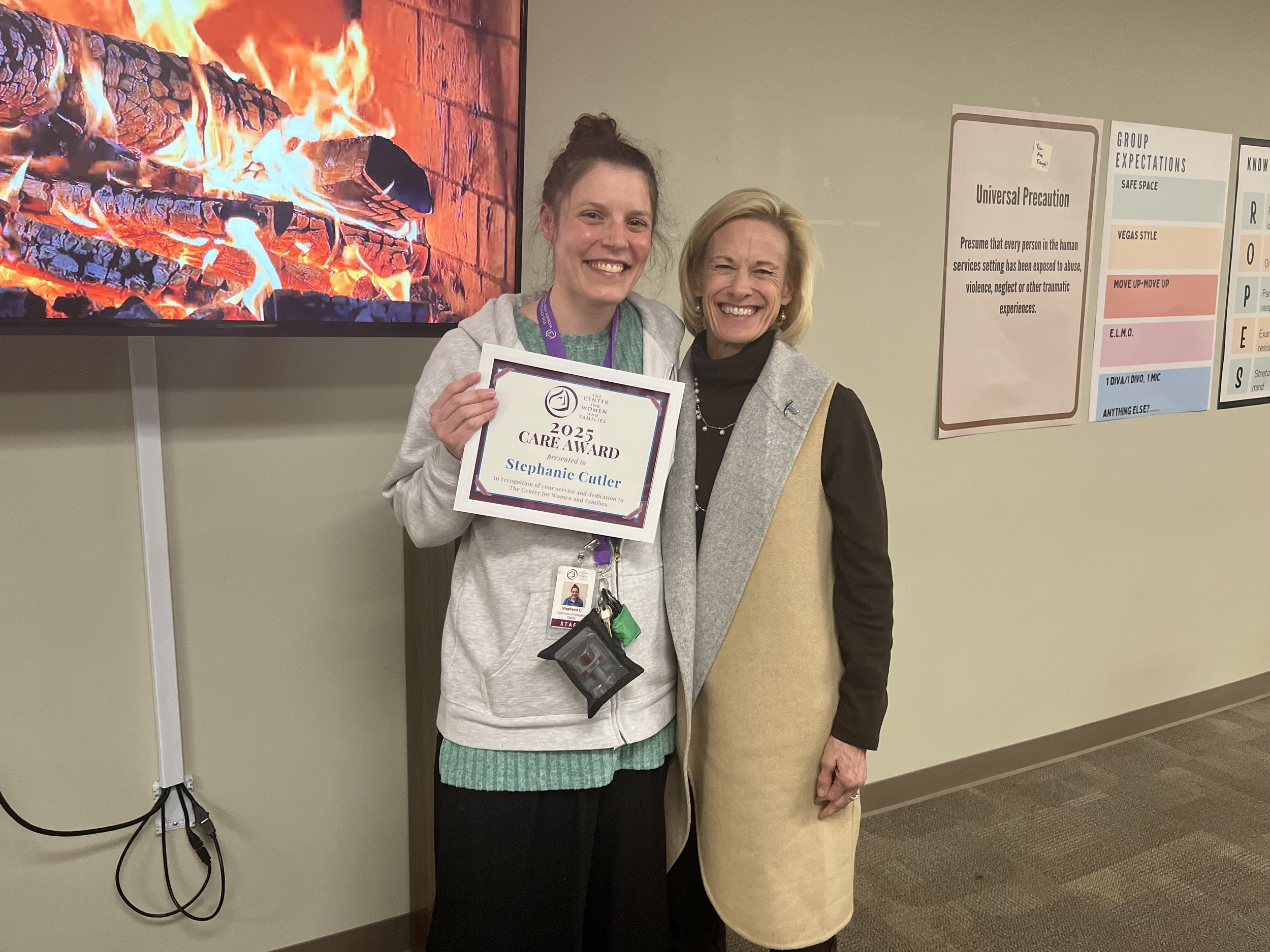
Emergency Shelter Supervisor Stephanie Cutler is pictured with Elizabeth Martin, The Center’s President and Chief Empowerment Officer, at the holiday luncheon where she was recognized as the 2025 Care Award recipient.
Spotlight Q&A: Stephanie Cutler, Emergency Shelter Supervisor
We are excited to highlight Stephanie Cutler, our Emergency Shelter Supervisor, in the first installment of this new series. Stephanie is not only a dedicated leader in our organization but also the 2025 Care Award recipient. This award is given to those who exemplify The Center's core values: non-violence, emotional intelligence, social learning, open communication, social responsibility, democratic values, growth, and change.
One of her colleagues expressed their admiration for Stephanie by saying, “I think Stephanie not only exemplifies all of our values at The Center in her work but models them for others. Her commitment to client care shows in everything she does, and her enthusiasm for making us better is constantly inspiring,” wrote her colleague. “Stephanie meets all employees with the belief that they are capable, promoting a positive and healthy work environment through the way she talks with and about clients and staff. I am always impressed with her ability to think through complex and difficult situations with empathy, accountability, and collaboration.”
Q&A with Stephanie Cutler
What inspired you to work at The Center with survivors of trauma?
Prior to 2021, I had never heard of The Center. During a Community Partnerships summer class in my school counseling master's program, we had a project in which we were asked to create a presentation about an important community organization, and I happened to choose The Center. As I researched the organization, primarily gathering a wealth of information from the website, I was amazed by the programs and supports offered to survivors. I thought, however, that it would be a useful referral organization and nothing more.
Then, as I was applying for various jobs after graduate school, I saw a Children's Advocate position open at The Center. I have always loved working with children, and I knew that violence affects all members of the household, including children.
If you've ever worked with me, you have doubtlessly heard me say a million times, "There are no bad children - only children who have had bad things happen to them;" I believe that children who are acting in destructive, harmful, or difficult ways are trying to navigate a complex world, protect themselves, deal with their feelings and trauma, and make sense of what has happened to them. With this mindset, I wanted to help children who had witnessed or experienced household IPV/SV, knowing that early unconditional support and care can be a major resiliency factor for children. This led me to apply and accept the Child Advocate position at the Center, beginning my work on October 31, 2022.
What trends are you observing in your work with clients regarding common issues clients face, their needs, and the types of abuse you frequently encounter? How can the community support these needs?
Working in the emergency shelter, it's difficult to summarize the various needs and barriers that clients face. Obviously, in order to screen into the emergency shelter, clients must endure severe intimate partner and/or sexual violence that leads to a heightened risk of lethality. Along with brutal physical violence, our clients experience extensive emotional and psychological abuse (especially gaslighting and diminishing), physical and emotional isolation from loved ones, and strictly controlled activities. With the level of violence - and the ongoing nature of it in their relationships - many of our shelter clients struggle with substance use and mental health concerns, which often reinforce each other.
Substance use is a coping mechanism, which we in shelter understand and do not judge; unfortunately, it frequently creates a barrier for goal attainment and self-sufficiency. There are plenty of treatment programs out there, but a greater problem is that 10-28 days in a treatment program are not enough. Our clients frequently do not have the systematic, relational, or financial supports to keep themselves stable after going through recovery programs (especially once they transition from shelter) - they enter these programs with very few resources, leave with few resources, and are expected to maintain solid footing and sobriety while struggling with basic needs.
One of the most critical gaps in our community are true wrap-around, comprehensive supports for folks in recovery, especially those who are struggling with the complex trauma often accompanying intimate partner and sexual violence. These people are basically shunned by our communities instead of embraced by them as struggling people attempting to put their lives back together. If we had accessible programs that truly support the whole person and recognize the complex web of barriers faced by survivors in recovery, the future would look much different and much brighter for these survivors.
Why is the work we do at the Center important, and why should the community care about the work at The Center?
It is hard to put into words why the work we do here at The Center is important. While the many direct client services we provide are critical for enhancing client safety, self-sufficiency, and resource acquisition, I believe that the most important thing we do is recognize survivors as human beings who need and deserve unconditional positive regard, firm but kind boundaries, relevant information (about intimate partner and sexual violence resources, therapeutic supports), and effective supportive programming.
Many of our survivors face a sense of isolation from their loved ones, from their communities, and especially from themselves - the true selves that they want to be and can be. They feel helpless, silent, diminished, and unseen.
At the Center, we do our best to see and meet clients where they are without judgment, believing not only their stories but believing in their foundational and irrevocable worth as people. We recognize the importance of their voices, their perspectives, and their experiences, emphasizing that they are worthy of love and life because they exist and that they deserve safe and productive futures on their own terms.
Whether communicating with clients on the crisis line, meeting them at court or in the community, or engaging in safety planning and case management in shelter, we at the Center provide the unique space for survivors to exist as they are, voice their struggles and their aspirations, build resilience, and find the strength that has always been there inside - after all, they have survived this long, many under heinous and unbelievably violent circumstances. This is why the community should care about our work — because we provide comprehensive programming for survivors that addresses their diverse and myriad needs and do so by using a trauma-informed approach that universally acknowledges the intrinsic worth, strength, and humanness of survivors. All people need to be seen, heard, acknowledged, and valued, and this is at the core of what we do at the Center - this is where disrupting the cycle of violence begins.
You dedicate your days to caring for others. What does self-care look like for you?
In practical terms, self-care for me is very simple: I greatly enjoy reading and taking long walks with my fun-loving and chaotic German Shepard-Husky, Mando. I also watch movies and enjoy the outdoors with my partner. Additionally, I like to process my thoughts and feelings through writing, and I keep a daily gratitude journal to consistently remind myself of all the fortunate things in my life.
More than anything, self-care is consistently reminding myself that I am doing my best, that kindness matters, and that I am capable of navigating and overcoming difficult days. I consistently ask myself, "What do you have control over in this situation? For the things I have control over, do something. For the things I don't, feel and process the emotions and then let it go, because allowing myself to be dragged down by the weight of things I cannot control does not serve me."
When emergencies and crises arise, I also ask myself, "Did I do everything I could with the information I had at the time?" If the answer is "Yes," then I let go of the rest. I also keep in mind that every single day - every single interaction with a survivor and with another person - is an opportunity to communicate kindness and care, and while we may never know the difference it makes, it does make a difference - and reminding myself of that brings me peace and calm in my life.
What do you enjoy most about working at The Center?
This may sound trite, but I truly love working with the clients. I always say that working at The Center consistently makes me a better person. Our clients are some of the most incredible and awe-inspiring people I have ever met, and I am a better person for having known and worked with them. They have taught me so much about the world - both about its deep, dark corners and the brilliance of resilience.
Our clients have endured hardships, the likes of which I can only imagine, and they are still here - they are still fighting for a different future for themselves and for their families. They show us all every day that healing is possible. They are some of the most creative and industrious people, consistently finding solutions to basic and advanced problems and finding ways to meet their needs. They are brave - in raising their voices to speak on their experiences, in opening up their vulnerability and examining the emotional wreckage of the trauma they've endured, and in taking the next step forward and the one after that.
I love my job - I could go on and on for days about all that I love about it - but, at the core of it all, the clients make the work worthwhile, and I am grateful for every moment that they have invited me into their lives.
What is your Favorite quote?
"You don't ever have to do anything sensational for people to love you." - Fred Rogers